Iberian ham glossary
The Iberian sector has a vocabulary of its own that mixes livestock terminology, European regulation and a century-old craft. We’ve gathered in this dictionary the terms that come up again and again on labels, in counter conversations and in features, with clear, verifiable definitions. Use it as a quick reference: each entry is in alphabetical order (by its Spanish term, the one you’ll see on labels) and, where it exists, we link to the guide where we explain the concept in depth.
A
- AECERIBER: the Spanish Association of Breeders of Select Purebred Iberian Pig. A sector body that works on conserving the purebred Iberian breed and manages the breed’s genealogical register together with other associations recognised by the Ministry of Agriculture.
- ARCERIBER: the Association of Iberian Pig Breeders, another of the sector bodies devoted to promoting and improving the breed. Alongside AECERIBER it takes part in the official breeding and genetic-selection programmes.
- Añada (vintage): the specific year of the piece’s making or slaughter. Just as with wine, each añada has different nuances depending on how the montanera went, the rainfall or the curing temperatures.
- ASICI: the Iberian Pig Interprofessional Association. The body responsible for managing the placement of the mandatory colour seals on each leg. More in bands and seals.
B
- Bellota (acorn): the fruit of the holm oak and cork oak that forms the dietary base of the Iberian pig during the montanera. It provides the unsaturated fatty acids (especially oleic) responsible for the aroma, flavour and texture characteristic of premium ham. More in how to choose Iberian ham.
- Bodega (cellar): the area of the factory where the ham completes its maturation once the drying-room phase is over. In Guijuelo, the natural cellars make use of the altitude climate and the cold winters. More in how to keep your ham.
- Brida: the technical name for the tamper-proof plastic seal that ASICI places on the leg. There have been four mandatory colours since 2014: black (100% Iberian acorn-fed), red (75% or 50% acorn-fed), green (free-range grain-fed) and white (grain-fed). More in bands and seals.
C
- Caña (shank): the area of the ham running from the hoof to the start of the maza. It’s the narrow, elongated part of the piece, where the PDO band is usually tied.
- Cebo (grain-fed): the most accessible Iberian category. Pigs raised in intensive systems and fed cereal and legume feeds. Carries a white seal. More in how to choose Iberian ham.
- Cebo de campo (free-range grain-fed): the intermediate category. Pigs raised in freedom or semi-freedom in the open air, on natural feeds and with use of the field, but without an exclusive montanera. Carries a green seal. More in how to choose Iberian ham.
- Contramaza: the side opposite the maza, narrower and with a slightly more intense cure. The meat is somewhat drier and more concentrated in flavour. More in how to carve your ham.
- Coppa: an Italian charcuterie product made from the pig’s neck area. We mention it because it’s often confused with Iberian cured loin, although they are different products.
- Corte a cuchillo (knife carving): the traditional slicing technique that respects the piece’s temperature, texture and aroma. It requires a ham holder, a ham knife, a paring knife and craft. More in how to carve your ham.
- Corte a máquina (machine slicing): mechanical slicing, usually for packaged presentations. It’s practical for large volumes, but knife carving is still preferred in restaurants and premium home consumption. More in how to carve your ham.
- Curación (curing): the complete process of transforming fresh ham into cured ham, including salting, post-salting, drying room and cellar. In acorn-fed Iberian it usually exceeds 30 months. More in how to keep your ham.
D
- Dehesa: the agro-silvo-pastoral ecosystem characteristic of the south-western Peninsula, formed by managed holm-oak and cork-oak woodland where the Iberian pig is raised in the montanera. The word “dehesa” on a label is reserved by law for acorn-fed products.
- Deshuesado (boning): the operation of removing the bone from the piece to make slicing or packing easier. A good boning preserves the ham’s natural geometry and allows the maza, contramaza and babilla formats to be recovered.
- DOP (PDO): Protected Denomination of Origin. A European quality instrument certifying that a product has been made in a specific geographical area following a specification. For Iberian ham there are four: Guijuelo, Jabugo, Dehesa de Extremadura and Los Pedroches. More in the Guijuelo PDO explained.
- Duroc: a North American pig breed authorised by the Iberian Pork Quality Standard to be crossed with a 100% Iberian sow. The offspring of that cross give the 50% Iberian-breed hams.
E
- Encina (holm oak): a Mediterranean tree (Quercus ilex) whose acorn is the basis of the montanera. Together with the cork oak and the Portuguese oak, it shapes the landscape of the dehesa.
- ENAC: the National Accreditation Body. The Spanish body that accredits the independence and technical competence of the certification bodies that verify compliance with the Iberian Pork Quality Standard and the PDO specifications.
G
- Genealógico (libro) — genealogical register: the official register where 100% purebred Iberian animals are recorded. It’s the only way to guarantee breed purity, an essential requirement for a ham to carry a black seal.
- Grasa infiltrada (infiltrated fat): veins of intramuscular fat that appear as white “veins” within the muscle. They are the signature of a well-fattened Iberian pig and responsible for juiciness and aroma in the mouth.
- Guijuelo: a town in Salamanca and a historic Iberian-ham district, home of the first Iberian-ham PDO in Spain (1986). The term on a label is reserved for products certified by the Regulatory Council. More in the Guijuelo PDO explained and in our dehesa.
H
- HYCER: a sector health-management and traceability programme linked to Iberian, used by abattoirs and drying houses to record each piece’s cycle.
I
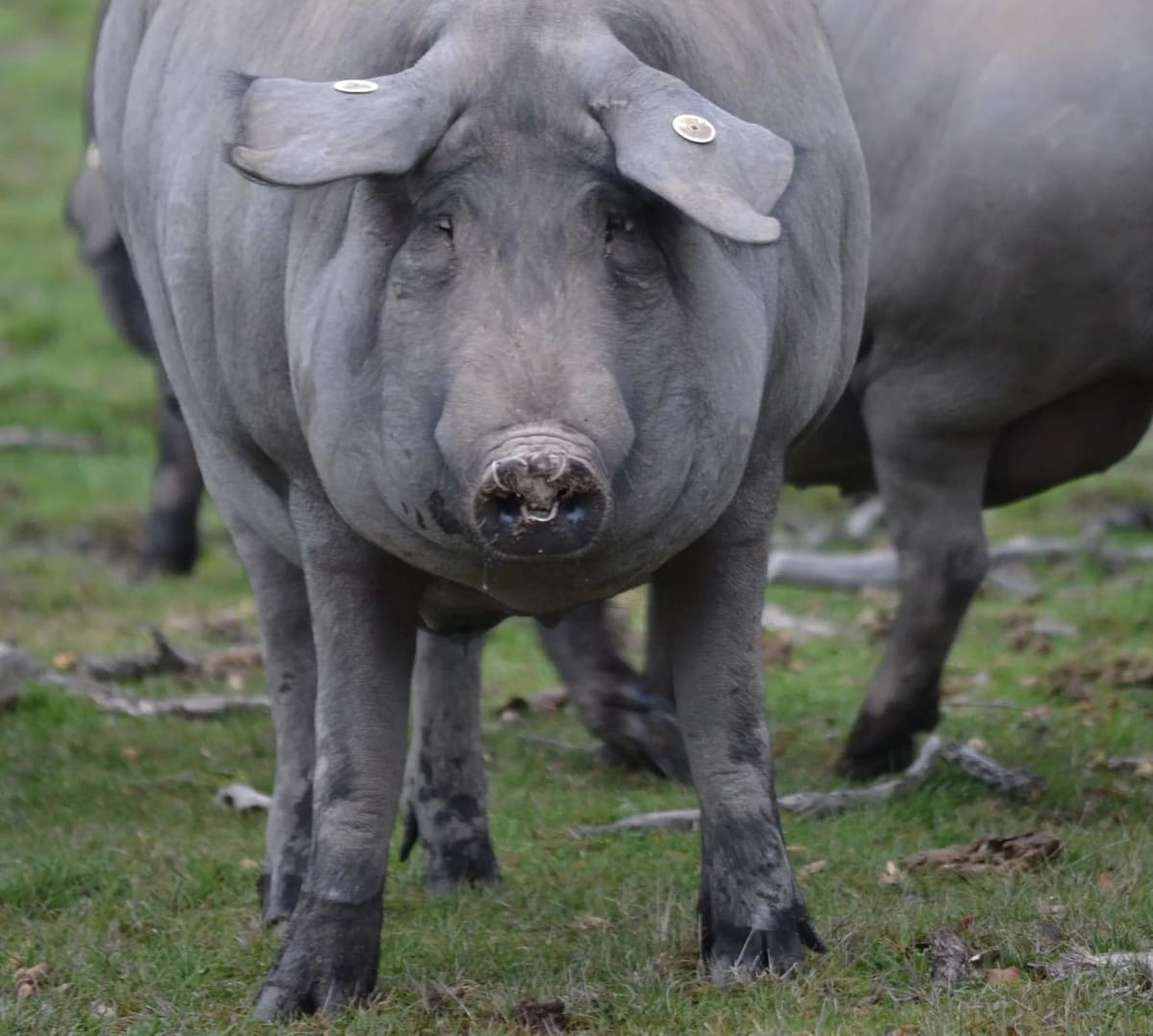
- Ibérico (Iberian): a pig breed native to the south-western Peninsula, with a genetic stock distinct from the industrial white pig. Its ability to infiltrate fat and make use of the acorn is the basis of the sector’s whole product range.
- IFFA: the German international meat-industry trade fair (Internationale Fleischwirtschaftliche Fachausstellung). A reference event for technology, machinery and trends in the global charcuterie industry.
- IGP (PGI): Protected Geographical Indication. A European instrument less demanding than the PDO, in which only one phase of production must take place in the protected area. It isn’t used for cured Iberian ham, but it is for other Spanish meat products.
J
- Jabugo: a PDO in the Huelva sierra, one of Spain’s four Iberian-ham denominations.
- Jamonero (utensil) — ham holder: a wooden or metal stand where the piece is immobilised to carve it safely. Without a good ham holder, knife carving is impossible. More in how to carve your ham.
- Jarrete (hock): the lower area of the leg, next to the hoof, where the meat is more fibrous and tough. It’s used in diced pieces for stews or stocks. More in how to carve your ham.
L
- Lingote (block): a format of boned, rectangular-pressed ham, ready for machine slicing. Practical for hospitality and distribution, it sacrifices part of the presentation in exchange for yield.
- Loncheado (sliced): a presentation of ham already cut into thin slices and vacuum-packed in envelopes. It allows individual consumption and prolonged keeping, although the sensory experience never matches the freshly carved.
M
- Maestro jamonero (master ham-maker): the professional responsible for controlling the cure inside the factory. They decide the times in each chamber, the cellar entry and the optimal point of sale of each piece. In our house this craft has been handed down over four generations. More in our company.
- Maestro cortador (master carver): the professional specialised in the knife carving of Iberian ham, with specific training in the piece’s anatomy, slice geometry and plate presentation.
- Magro (lean): the muscular part with no visible fat. In tasting, the balance between lean and infiltrated fat is valued, never the lean alone.
- Marbling (veteado): the pattern of intramuscular fat in fine veins. In well-fattened acorn-fed Iberian, the marbling is dense and regular.
- Maza: the main side of the ham, the widest and juiciest. It’s the area where carving begins and where the balance between lean and infiltrated fat is most evident. More in how to carve your ham.
- Montanera: the autumn–winter period (roughly October to March) in which Iberian pigs fatten in the dehesa feeding exclusively on acorns, grass and other natural resources. The length and quality of the montanera determine the ham’s final category.
- Morcón: an Iberian cured sausage made from noble cuts of the carcass, stuffed in a thick casing. It shares raw material with the loin and the presa, with a prolonged cure. More in Iberian charcuterie from Guijuelo.
N
- Norma del Ibérico (RD 4/2014) — the Iberian Pork Quality Standard: the Royal Decree that regulates the quality of Iberian meat, ham, shoulder and loin in Spain. It defines the four categories, the breed percentages, the authorised diet and the seal system.
P
- Pata Negra: a designation reserved by the Iberian Pork Quality Standard exclusively for 100% Iberian acorn-fed hams (black seal). Using the term in any other category is a legal infringement. More in how to choose Iberian ham.
- Pezuña (hoof): the distal end of the leg, formed by the pig’s nails. Its dark colour in the Iberian is the popular origin of the term “pata negra”, although it isn’t reliable proof of breed: there are white pigs with black hooves and Iberian pigs with light hooves.
- Precinto (ASICI) — seal: a tamper-proof plastic band placed by ASICI at the abattoir. Four mandatory colours by category. Carrying a seal is a legal condition for a piece to be sold as Iberian. More in bands and seals.
- Presa: a noble muscle cut of the Iberian pig, located in the loin-collar area. Highly prized fresh, with high fat infiltration.
- Punta del jamón (ham tip): the area opposite the hoof, where the shank begins at the other end. It’s one of the most cured areas and the most intense in flavour. More in how to carve your ham.
R
- Rancidez (rancidity): oxidative deterioration of the fats producing unpleasant flavours and smells. In well-cured and well-kept ham it’s very infrequent. It usually appears from exposure to light, heat or excessive storage times.
- Reglamento UE 1151/2012 — Regulation (EU) 1151/2012: the European rule establishing the common framework of quality schemes for agricultural products and foodstuffs, including PDOs and PGIs. It’s the legal basis for the protection of “Guijuelo” at EU level.
- Recebo: an intermediate category removed by the 2014 Iberian Pork Quality Standard. It designated pigs that finished the montanera with a feed supplement. Today the term is banned on labels.
S
- Salazón (salting): the first phase of the cure. The piece is covered in sea salt for roughly one day per kilo of weight, which begins dehydration and preservation.
- Secadero (drying room): the factory chamber where the ham loses water in a controlled way before going to the cellar. The duration depends on the weight, the category and the conditions of each añada. More in how to keep your ham.
- Sierra de Béjar: a mountain range in southern Salamanca that bounds the natural area of the Guijuelo PDO to the north. Its altitude and cold winters are one of the factors that explain the quality of the cure in the district. More in our dehesa.
T
- Tocino (fatback): the pig’s subcutaneous fat layer. In Iberian ham it acts as a protective cover during the cure and brings characteristic aromas. In the finished piece, part of the outer fatback is removed when carving. More in how to keep your ham.
- Trazabilidad (traceability): the ability to follow a piece’s path from the farm to the final consumer. In Iberian it’s guaranteed through the unique number of the ASICI seal and the certification body’s records.
V
- Vitola (band): an optional cardboard or plastic band that wraps the shank of the ham when the piece is covered by a PDO. It carries the Regulatory Council logo and its own qualification number. More in bands and seals.
Hernández Jiménez has been making Iberian ham in Guijuelo since 1890. We are co-founders of the Guijuelo PDO (1986), four generations of master ham-makers, an output of around 40,000 pieces a year and a natural cellar at 1,000 metres of altitude. If after reading the glossary you have a terminology question, an entry you think is missing or a nuance you’d like to discuss, write to us at info@jamongourmet.es. A member of the family will reply.