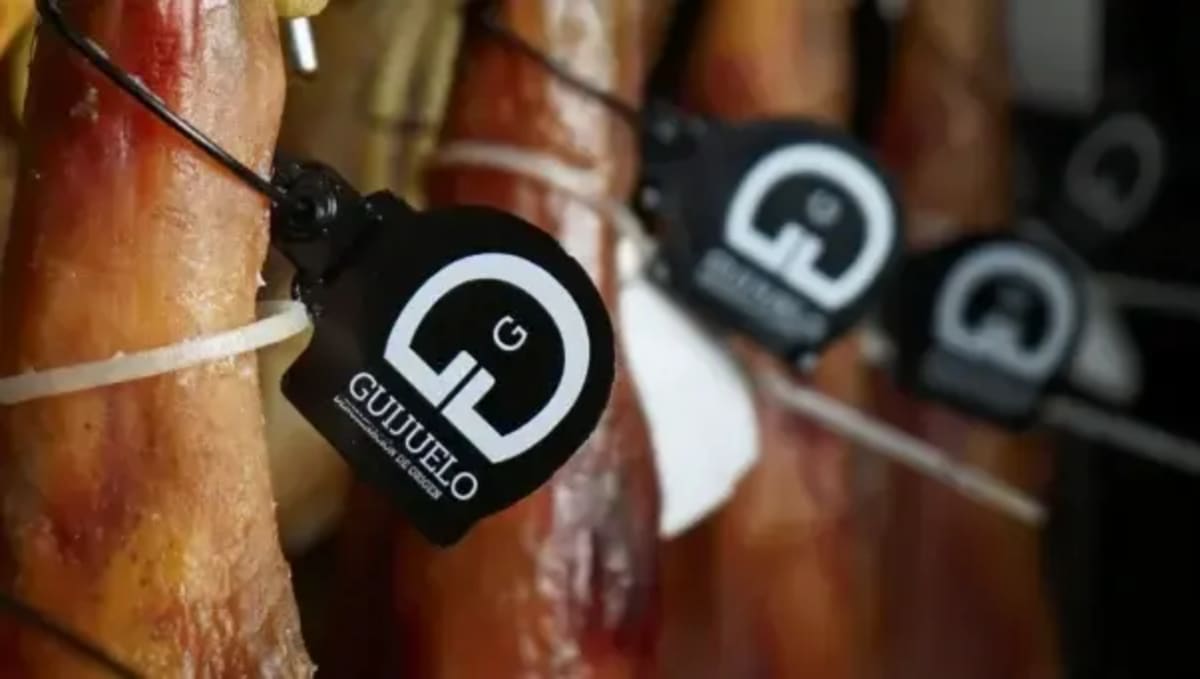
Guijuelo PDO: what it is, its history and how to identify it
When someone asks us why a ham with the Guijuelo PDO mark costs more than an uncertified “Salamanca” ham, the short answer is: because behind the mark there are almost forty years of audits, a specification approved by the European Union and a Regulatory Council that controls every piece one by one. The long answer is this guide.
Through the text we’ll look at what a Protected Denomination of Origin is, why it matters, what the four Iberian-ham PDOs in Spain are, what makes the Guijuelo PDO unique since 1986, how to recognise it on a specific piece, and what role our house, Hernández Jiménez, played as a co-founder of the Regulatory Council.
What a Protected Denomination of Origin is and why it matters
A Protected Denomination of Origin (PDO) is a European legal instrument, today regulated by Regulation (EU) 1151/2012, that protects agri-food products whose quality, characteristics or reputation are due fundamentally to the geographical environment, including natural factors (climate, soil, altitude) and human factors (know-how, tradition, local techniques).
It is not a marketing label. For a product to carry a PDO, three conditions must be met simultaneously:
- Production, transformation and processing occur entirely within a delimited geographical area.
- There is a public specification detailing breeds, diet, curing times, methods and controls.
- An independent Regulatory Council verifies compliance through external audits, normally accredited by ENAC (the National Accreditation Body) under standard ISO/IEC 17065.
The difference from a PGI (Protected Geographical Indication) is important: in a PDO the whole process occurs in the area; in a PGI it’s enough for one of the phases to occur there. That’s why a PDO is the most demanding European instrument for origin protection.
For the consumer this translates into three concrete guarantees: traceability (each piece has a number that allows it to be followed from the dehesa to the plate), authenticity (what the label says is what’s there) and a minimum quality standard verifiable by an independent third party.
The four Iberian-ham PDOs in Spain
In Spain there are exactly four Protected Denominations of Origin for Iberian ham. Each protects a different geographical area, with its own climate, tradition and sensory profile.
| PDO | Area | Province(s) | Year recognised | Microclimate |
|---|---|---|---|---|
| Guijuelo | Sierra de Béjar and district | Salamanca, Ávila, Cáceres, Segovia, Zamora | 1986 | Cold dry, high altitude (~1,000 m) |
| Jabugo | Sierra de Aracena | Huelva | 1995 | Humid, mild, Atlantic |
| Dehesa de Extremadura | Extremaduran dehesas | Cáceres and Badajoz | 1990 | Warm continental |
| Los Pedroches | Los Pedroches valley | Córdoba | 2010 | Dry continental, medium altitude |
Each microclimate produces a different ham. Those from Jabugo tend to be more unctuous because of the slow cure in a humid environment. Those from Dehesa de Extremadura and Los Pedroches usually have more intense profiles, with meatier notes. Those from Guijuelo, thanks to the cold dry air of the Sierra de Béjar, develop a smoother, sweeter, cleaner flavour, with lower saltiness. None is better than another: they are different traditions yielding different products, just as with great wines.
If you are looking for the best Iberian ham from Guijuelo online, this smoother, sweeter, cleaner profile is exactly what you will find — cured at 1,000 m altitude, straight from the cellar.
History of the Guijuelo PDO
The Guijuelo PDO was officially recognised in 1986, making it the first Protected Denomination of Origin for Iberian ham in Spain. Before Jabugo, before Extremadura, before Los Pedroches.
The Guijuelo district has been making Iberian ham by hand for over 130 years. The first generation of the town’s industrial producers settled at the end of the 19th century, when they discovered that the constant cold dry air of the Sierra de Béjar was the perfect ally for curing Iberian pork. What in other areas required artificial interventions (chambers, heating, dehumidification), in Guijuelo the climate gave for free.
By the 1980s, a group of historic producers in the town decided to formalise what for a century had been a tacit agreement: that Guijuelo ham was recognisable, distinct, and deserved legal protection against imitations. Among those co-founders of the Regulatory Council in 1986 was our house, Hernández Jiménez, present in Guijuelo since 1890 and with four generations of craft behind it.
Official recognition came by ministerial order of 30 November 1986, and since then the Regulatory Council has amended the specification on several occasions, the last in 2025 to extend coverage to pigs crossed at 50% Iberian. But the core remains intact: acorns from the dehesa, the cold of Béjar, time.
The microclimate of Guijuelo
The key to the Guijuelo PDO is the climate. The area sits on the foothills of the Sierra de Béjar, at around 1,000 metres of average altitude, making it one of the highest ham-curing areas in Europe.
The relevant climatic features are four:
- Cold, long winters, with average temperatures below 5 °C between December and February.
- North and north-west winds that cross the sierra and reach the natural cellars dry and clean.
- Low relative humidity for most of the year, especially in autumn–winter.
- Cool summers compared with the rest of the Spanish ham-curing areas, thanks to the altitude.
This translates into a slower, more stable cure. Whereas in warmer areas the ham loses water quickly and the salt penetrates intensely, in Guijuelo the process is drawn out, the enzymes work slowly and the salt diffuses more evenly. The result is a recognisable sensory profile: lower perceived saltiness, more pronounced sweetness, a long, clean aftertaste, smooth fat that infiltrates without saturating.
That’s why we say the climate is not an anecdotal detail but the differentiating factor that justifies the PDO’s very existence. The same pig, cured in Guijuelo or in a southern cellar, would give two different hams.
Breeds and diet permitted in the PDO
The current Guijuelo PDO specification admits pigs of three genetic compositions, always with a 100% Iberian mother registered in a genealogical register:
- 100% Iberian: 100% purebred Iberian father and mother.
- 75% Iberian: 100% Iberian mother, 50% Iberian father.
- 50% Iberian: 100% Iberian mother, authorised Duroc father.
As for diet, the PDO covers the categories regulated by the Iberian Pork Quality Standard (Royal Decree 4/2014):
- Acorn-fed: pigs in the montanera, with a minimum of 1 hectare of dehesa per animal, fed exclusively on acorns, grass and natural resources of the dehesa between 1 October and 31 March.
- Free-range grain-fed: pigs in freedom or semi-freedom, on natural feeds of cereals and legumes, supplemented with pasture.
The PDO specification has been adjusted over the years; it’s worth consulting the version in force with the Regulatory Council to see which specific combinations of breed and diet are covered at any given time. In general, the core of the Guijuelo PDO is the highest-quality acorn-fed and free-range grain-fed Iberian.
If you want to go deeper into the seal colours, the protected terms and how the categories are told apart visually, we explain it piece by piece in our guide to bands and seals.
Minimum cure by category
The Guijuelo PDO specification sets curing times higher than the general Iberian Pork Quality Standard. These are minimums: in our house, many pieces far exceed them.
- Guijuelo PDO acorn-fed ham: a minimum of 24 months of curing. Premium pieces can exceed 36 and even 48 months.
- Guijuelo PDO free-range grain-fed ham: a minimum of 18 months of curing.
- Guijuelo PDO shoulder: a minimum of 12 months (shoulders, being smaller, cure in less time than hams).
Curing is done entirely within the PDO area, in natural cellars at the regulatory altitude. Taking the piece out of the area during the cure breaks traceability and the piece loses the mark.
How to identify a Guijuelo PDO ham
A piece certified by the Guijuelo PDO carries three visible identifying elements that the consumer can check:
- The tamper-proof ASICI seal in the colour corresponding to the category (black for 100% acorn-fed, red for 75%/50% acorn-fed, green for free-range grain-fed). This seal is carried by all legal Iberian in Spain, PDO or not.
- The Guijuelo PDO band (vitola) wrapping the shank of the ham, with the Regulatory Council logo and a unique qualification number assigned to that specific piece.
- A complementary Regulatory Council seal or label, usually white with the PDO crest, showing the authorised producer number and the lot.
That unique number makes it possible, in case of doubt, to consult the Regulatory Council and confirm that the piece is indeed registered in its records. It isn’t a decorative mark: it’s an entry in an auditable database.
If a piece says “Guijuelo” on the label but carries no PDO band, that mention is illegal. The term “Guijuelo” is a protected name, exactly like “Champagne” or “Rioja”: it can only be used commercially under the Regulatory Council’s protection.
Audits, traceability and independent control
The Guijuelo PDO Regulatory Council does not self-certify. Compliance audits against the specification are carried out by external certification bodies accredited by ENAC under standard ISO/IEC 17065, which governs the bodies that certify products in Europe.
This means three levels of independent control:
- Farm inspections: field verification of stocking densities, diet, breeds, montanera periods.
- Abattoir and drying-room controls: weights, dates, records, salting, curing.
- Documentary and random audits of each lot’s traceability.
Each piece is linked to an individual registration number that allows its full history to be reconstructed: farm of origin, slaughter date, cellar-entry date, exit date, commercial lot. If you ask for the traceability of one of our pieces, within 48 hours we send you that full history. It’s a consumer right worth exercising.
If you want the detail of our certifications and audits, we gather it on the quality and certifications page.
Hernández Jiménez and the Guijuelo PDO
Our house, Hernández Jiménez, has been in Guijuelo since 1890. Four generations of the same family have devoted themselves to making ham in this district, first as an artisanal drying house and later, once established as F. Hernández Jiménez e Hijos S.L., as a recognised industry of the sector.
When the Guijuelo PDO Regulatory Council was constituted in 1986, Hernández Jiménez was among the producers who signed the founding deed. This isn’t an anecdotal detail: co-founding a PDO implies having spent the previous decades making the product you want to protect. The PDO didn’t create our way of working; it simply put a legal framework around something that already existed.
Today we put around 40,000 pieces a year on the market under the PDO mark, cured entirely in our natural Guijuelo cellar at around 1,000 metres of altitude, with the same criteria we applied three generations ago. You can read the full story on our Los Hernández Jamón page.
If you want to try our hams with the Guijuelo PDO band, these are the most representative:
- Summum 100% Iberian acorn-fed ham, Guijuelo PDO: our premium selection, long cures and pieces chosen one by one.
- Pata Negra 100% Iberian acorn-fed ham, Guijuelo PDO: the house classic, black seal + PDO band.
- 75% Iberian acorn-fed ham, Guijuelo PDO: acorn-fed with a 75% cross, red seal + PDO band.
Frequently asked questions
Is every ham made in Guijuelo a PDO ham?
No. In the district there are producers under the PDO and producers who have chosen to stay outside it, whether because they don’t want to take on the specification’s demands, because they work categories that aren’t covered (intensive grain-fed, for instance) or for commercial reasons. A ham produced in Guijuelo but without the PDO mark is perfectly legal, but cannot use the name “Guijuelo” commercially on its label.
What external difference does a Guijuelo PDO ham have versus one that isn’t?
The visual difference is the PDO band wrapping the shank and the Regulatory Council seal with a unique number. The ASICI seal (black, red, green or white) is carried by all legal Iberian whether PDO or not; what’s distinctive about the PDO is the band and the complementary seal.
Are “pata negra” and “Guijuelo PDO” the same thing?
No, they are different things and it’s worth being clear about it.
- “Pata negra” is a term reserved by the Iberian Pork Quality Standard for 100% Iberian acorn-fed ham, regardless of geographical area. A pata negra may come from Huelva, Extremadura, Salamanca, Córdoba or any other authorised Iberian area.
- “Guijuelo PDO” is a denomination of origin: it protects the geographical area and the production method, but includes several categories (100% acorn-fed, 75% acorn-fed, 50% acorn-fed, free-range grain-fed).
A piece can be pata negra without a PDO (100% acorn-fed from another area or from a Guijuelo producer not under the Regulatory Council) and another can be Guijuelo PDO without being pata negra (for example, a 75% acorn-fed or a free-range grain-fed). When both coincide (pata negra with a Guijuelo PDO band), we have the most demanding combination: 100% Iberian acorn-fed cured under the mark of the oldest Regulatory Council in Spain.
How long does a Guijuelo PDO ham cure?
The specification requires a minimum of 24 months for acorn-fed and 18 months for free-range grain-fed. In practice, our premium pieces usually far exceed those terms, reaching 36–48 months in the highest selections.
Can I verify my piece’s number?
Yes. The number on the band and the Regulatory Council seal is registered in its records. If you buy one of our pieces and want to check it, you can request the full traceability document from us and, if you prefer, cross-check it directly with the Regulatory Council.
If you want to explore all available categories and current prices, visit our Guijuelo ham guide.
The Guijuelo PDO is not a decorative mark: it’s almost forty years of audits, a European specification and a tradition of over a century in the district. If after reading this you want to keep going deeper, we recommend stopping by our guide to bands and seals to learn to read Iberian labels in detail.