Where a good ham begins
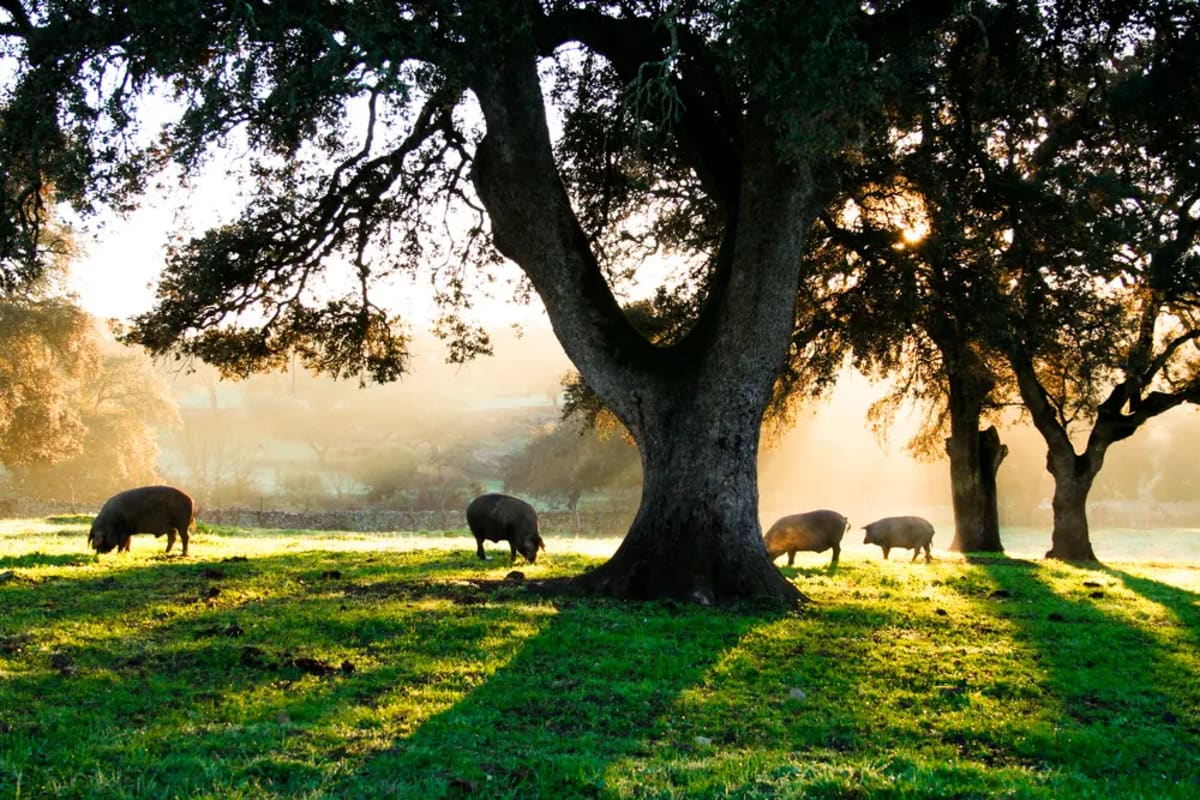
Before the cellar, before the salt, before even the maker’s name, there is one decision that defines the final flavour of an Iberian ham: how the pig it comes from has lived.
Our pigs live in the dehesas of Salamanca, Extremadura and Andalusia. Not on farms. Dehesas. And living well in a dehesa means meeting, every single day of the year, requirements that the law sets out in concrete figures.
What a dehesa is
A dehesa is a Mediterranean ecosystem unique in the world: a landscape of holm oaks and cork oaks spaced apart, with pasture beneath, where the tree gives shade to the animal and the plant, the animal fertilises the soil, and the plant feeds the animal. It is not woodland and it is not grassland; it is both at once, maintained by human hands for centuries.
The dehesa only works if it is cared for. And it is cared for because it produces, among other things, acorns. Each mature holm oak can produce between 8 and 15 kilos of acorns a year. Each Iberian pig in the montanera needs between 6 and 10 kilos of acorns a day during the four or five months the montanera lasts.
The numbers don’t add up if you want to cheat. That is why the Iberian Pork Quality Standard regulates the maximum stocking density per hectare in detail: the dehesa only carries as many pigs as its oaks can feed.
One hectare per pig, minimum
Our pigs enjoy a minimum of one hectare per animal, as required by the Iberian Pork Quality Standard (Royal Decree 4/2014) for pigs covered as “acorn-fed”. That hectare is theirs to run, root, dig and forage for acorns, grass, roots and bulbs. The more an Iberian pig moves, the better it distributes fat through its body, and that distributed fat is what later becomes the marbling in the slices.
The montanera
The montanera is the acorn-fattening season. By law it runs between 1 October and 15 December, which is when the pigs enter the dehesa. Slaughter takes place between 15 December and 31 March of the following year.
During those months the pigs eat no feed. They eat acorns, grass and whatever they find. It is the only feeding regime legally compatible with the “acorn-fed” (de bellota) designation. They reach the montanera weighing between 92 and 115 kg and leave it with a live weight of 160 to 180 kg. That weight gain, made on acorns alone, is what gives pata negra ham its characteristic flavour.
Our farmers keep health records for every animal and every holding. The Guijuelo PDO, ASICI and the Ministry of Agriculture audit those records to guarantee that what is sold as acorn-fed really was acorn-fed.
The three feeding designations
The Iberian Pork Quality Standard (RD 4/2014) recognises three ways of feeding an Iberian pig, each with its legal name and its colour-coded seal:
Acorn-fed — de bellota (black or red seal, depending on breed). Pigs slaughtered immediately after feeding exclusively on acorns, grass and other resources of the dehesa, with no supplementary feed. It is the summit of Iberian.
Free-range grain-fed — de cebo de campo (green seal). Pigs raised in freedom or semi-freedom on extensive or open-air intensive holdings, fed natural feeds of cereals and legumes, with the possibility of using pasture and field resources, but without being in an exclusive montanera.
Grain-fed — de cebo (white seal). Pigs raised in intensive systems in line with the standard, fed natural feeds of cereals and legumes.
All three are legal and all three have their place. What is not legal is confusing them, or using the words “dehesa” or “montanera” on products that are not acorn-fed.
The Iberian breed
The Iberian pig is a breed native to the Iberian Peninsula, with ancient origins in the Mediterranean pig. It is an animal that lays down fat infiltrated within the muscle, not only under the skin like other breeds. That is the difference you see when you cut a slice: the white running through the red — the famous marbling.
The Iberian Pork Quality Standard distinguishes three degrees of breed purity: 100% Iberian (purebred Iberian mother and father, recorded in a genealogical register), 75% Iberian (100% Iberian mother, 50% Iberian father) and 50% Iberian (100% Iberian mother, authorised Duroc father).
Only the 100% may be called pata negra, and only when they are also acorn-fed. In every other case, the words “pata negra” are forbidden on the label. If you see “pata negra grain-fed ham” anywhere, that place is breaking the law.
What this means in a slice
Living well in the dehesa, eating acorns during the montanera, slaughtering the pig at the right age and weight, salting it with little salt, drying it slowly and curing it for years in a natural cellar produces a ham you can recognise without looking at the label:
- Deep purple-red colour with pearly, glistening veins of fat.
- A deep aroma that recalls the dehesa: toasted acorn, holm oak, nuts.
- A sweet, lightly salted flavour with a long finish.
- A melting texture, because acorn fat has a very low melting point: it dissolves the moment it touches the tongue.
All of that begins in the dehesa. Without the dehesa, there is no ham.