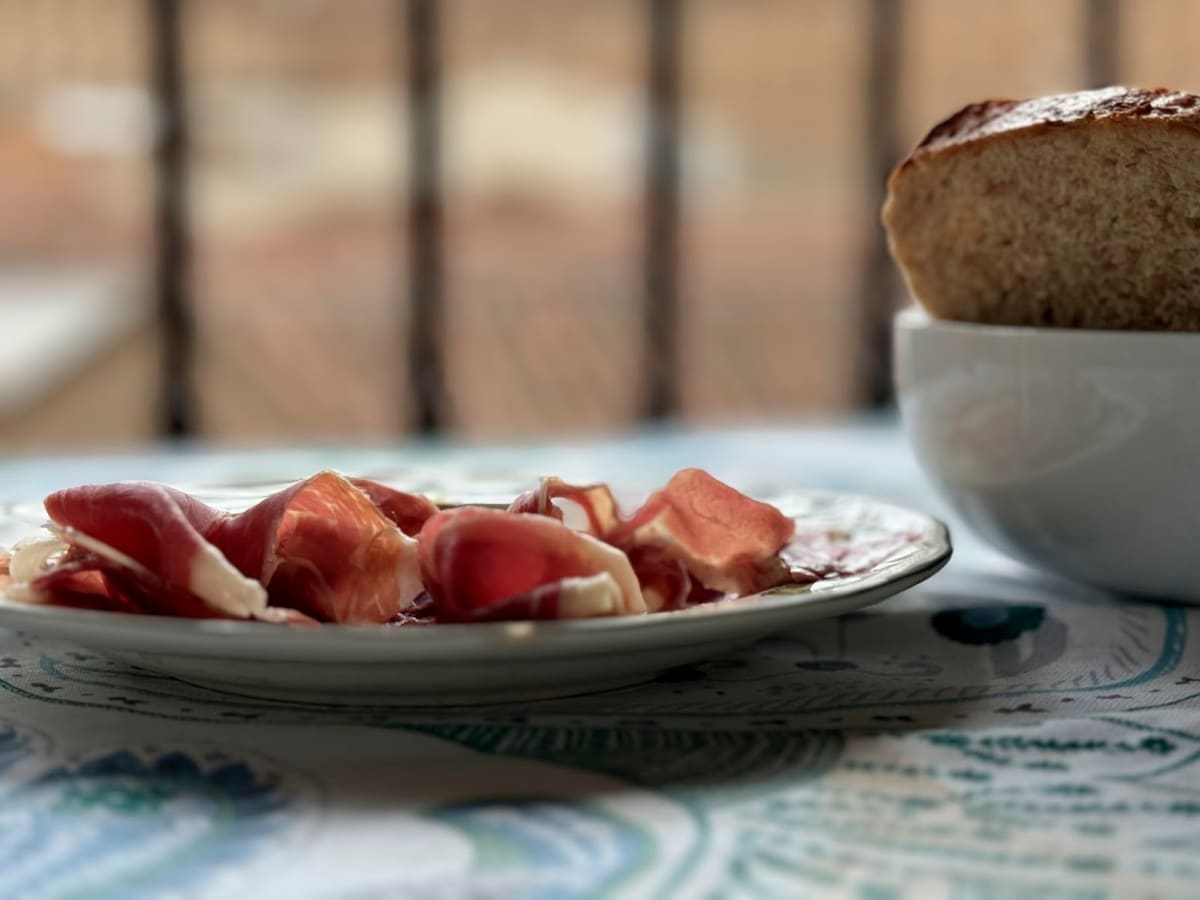
Pairings with Iberian ham: wines, cheeses and the perfect spread
Iberian ham is a soloist that likes a chorus. On its own, it’s already a party; well accompanied, it’s a feast. In this guide we tell you how we pair it here in Guijuelo, which wines never fail, which beers dare take on the acorn, which cheeses really match and how to put together a board for four without losing your mind. No posturing and no rules set in stone: drink what you fancy, but read this first in case we lovingly contradict you.
Ham wants company
Think for a moment about what happens in the mouth when you bite into an acorn-fed slice: fat that melts at body temperature, the sweetness of hazelnut, a salty base that calls for saliva, and that long-cure aroma reminiscent of woodland undergrowth. All of that looks for a companion that cleans the fat, goes with the sweetness and doesn’t smother the aromas. If the companion is very tannic, it scrapes. If it’s very sweet, it cloys. If it’s very cold, it numbs the palate. The good news is that there are many combinations that work, and almost all are reasonably priced.
Red wines
Let’s get to the point: heavy reds, very oaky and with green tannins, make ham suffer. We want the opposite. These are the ones we bring out when someone who knows turns up.
- Ribera del Duero crianza: tempranillo with 12–14 well-judged months in barrel. The ripe fruit of the tempranillo embraces the sweetness of the acorn, and the tannin, already polished, lifts the fat without attacking. Serve between 16 and 17 °C, not a degree more.
- Rioja reserva: the classic that never fails. Reservas with a long passage through barrel bring balsamic and leather notes that converse with the ham’s long cure. Look for balanced reservas, not the very oaky ones.
- Young Toro: tinta de Toro with little oak. It’s stronger than the Ribera, but its sweet fruit goes very well with an intense acorn-fed ham, especially if it’s spent years in the cellar.
- Young Mencía (Bierzo, Ribeira Sacra): vibrant red fruit, fresh acidity, light tannin. It’s our bet when it’s hot and nothing heavy appeals. Serve at 14–15 °C.
- Young Garnacha (Calatayud, Gredos): floral, spiced, very drinkable. It works wonderfully with free-range grain-fed ham and with a good Iberian acorn-fed chorizo on the same board.
Quick rule: if in doubt, less oak and fewer degrees. Ham is delicate and deserves a red that listens.
White and fortified wines
That Iberian ham only goes with red is one of the most stubborn myths of the Spanish table. And it’s false. In fact, in many Guijuelo homes more fino is uncorked than reserva.
- Rueda verdejo aged on lees, well chilled (8–9 °C): the lees ageing gives it volume and a creamy touch that accompanies the fat, and the verdejo’s acidity leaves the mouth clean for the next slice. If you find one with some barrel, even better with a long-cured ham.
- Manzanilla and fino, well chilled (6–8 °C): probably the technically most perfect pairing. The biological ageing under a veil of flor brings almond and bakery notes that are literally inside the ham’s aroma. The salinity of Sanlúcar manzanilla and the finesse of Jerez or Montilla fino are pure magic. If you can only do one experiment from this guide, make it this one.
- Albariño with good volume: Rías Baixas has tank-fermented albariños that are fresh but with body, especially those from Salnés and O Rosal. Look for ones with some ageing, not the youngest and sharpest. They work superbly with acorn-fed ham served in summer.
A note: with ham don’t uncork oaky or sweet whites. The first fight it, the second cloy.
Craft beers that work
Beer with ham is one of the most Spanish things there is, and you no longer have to limit yourself to ice-cold industrial lager. The Iberian craft-beer scene has grown enormously.
- IPA: yes, but with caveats. A very bitter, very resinous IPA overwhelms the ham. If you’re going to pair an IPA, make it with acorn-fed ham (the sweetness of the fat balances the bitterness) and choose maltier IPAs, like a balanced American IPA or an English IPA. Hazy/NEIPAs, with their fruitier, less bitter profile, also go well.
- A quality pale lager: a good Czech pilsner or a German helles, very cold, are the safe bet. Clean, refreshing, it makes way for the ham without fighting.
- Oat beer (a smooth oatmeal stout or a beer with oats in the recipe): the oats bring a silkiness in the mouth that accompanies the Iberian’s fat in a surprising way. If it’s your first time, try it with acorn-fed loin: the combination is moreish and surprising.
Cheeses that match
A well-thought-out ham-and-cheese board is a universe. Here are three safe bets.
- Aged cured Manchego: more than 12 months. We choose it for contrast: the dryness of the aged Manchego is balanced by the ham’s juiciness, and the nutty aromas of both rhyme. Cut the cheese into thin shavings with a knife, not thick wedges.
- Smoked sheep’s cheese (Idiazábal-type or smoked cheeses from Castile): the gentle smoke opens a new register that goes wonderfully with Iberian acorn-fed salchichón. The pepper of the salchichón and the cheese’s smoke are great friends.
- Fresh goat’s cheese with honey: a young, mild goat’s log with a drizzle of orange-blossom or rosemary honey. The contrast of the cheese’s acidic freshness, the honey’s sweetness and the ham’s saltiness is one of the most addictive bites you can build on a board. Try it on toasted bread with a slice of ham on top: dangerous.
How to put together a complete board for four people
This is the house recipe, no secrets. For four adults coming round to nibble before dinner:
- Quantities: reckon 50–80 g of ham per person if it’s a starter, up to 100 g if it’ll be the main course alongside the board. For four: between 250 and 350 g.
- Variety of cuts: offer thin slices from the maza (the juiciest area) and a few small dice from the punta for those who prefer to chew. Add cured meats: 80 g of chorizo, 80 g of salchichón and 80 g of loin. If you want to keep it simple, the Iberian tasting pack brings it all balanced.
- Cheeses: three types in small portions (60–80 g each) already make a generous board.
- Tasting order: from mild to intense. Start with the loin, follow with salchichón, then ham, and leave the chorizo and the cured cheese for the end. If you have knife-carved Iberian acorn-fed shoulder, put it right after the salchichón: it’s more intense than the ham and prepares the palate.
Ideal serving temperature
This is where people go wrong most. Iberian ham is served between 22 and 24 °C, the room temperature of a well-tempered living room. If you take it straight from the fridge or from the cool place where you keep the piece, take it out 15–20 minutes beforehand so the fat tempers and the slice melts in the mouth as it should.
A trick: the slices should always be warmer than the piece. So if you carve onto the same plate you’ll serve from, leave the plate at room temperature and don’t stack the slices too much. Better to serve them in a single layer or, at most, two.
Bread and accompaniments
- Toasted sourdough bread, an open crumb, a crunchy crust. Toasting activates the cereal aromas and goes with the Iberian’s fat much better than white bread.
- Thin breadsticks (Antequera-style or similar): the classic that never fails and lets you eat ham without mess.
- Arbequina extra-virgin olive oil: mild, fruity, sweet. A drizzle on the bread before the ham is a brutal upgrade. Avoid very intense, peppery picuals: they fight the Iberian.
- Grated tomato: bread with tomato and ham is debatable for purists, but if you like it, go ahead. That said, the tomato shouldn’t drown the slice: a thin layer and little salt.
Frequently asked questions
Can ham be paired with champagne or cava?
Yes, but look for brut nature or extra brut. Sparkling wines with residual sugar (brut, dry) clash with the sweetness of the acorn. A long-aged cava brut nature or a young, dry champagne work brilliantly, especially as an aperitif and in warm weather.
And with whisky or spirits?
Not very advisable. The alcohol level numbs the palate and kills the ham’s aromas. If you fancy a spirit, leave it for after the board.
Can ham be heated?
Never on a slice meant for tasting: heat melts the fat, evaporates the aromas and ruins the piece. The exception is Extremaduran migas, broken eggs with ham or crisps baked in the oven with shavings: here the ham plays another role and heat is accepted. For a board or a fine dish, cold or tempered, never hot.
How long does an opened piece last?
An opened ham, well covered with its own fat and a clean cloth, lasts between 3 and 6 weeks depending on humidity and temperature. In Guijuelo we’ve spent four generations caring for pieces; if you have specific questions, write to us.
At Hernández Jiménez we’ve been in Guijuelo since 1890 and we co-founded the PDO in 1986. If you’re up for a tasting at home and would like us to advise you on the selection, write to us at info@jamongourmet.es: we’ll help you put together the board that best fits your wines and your occasion.