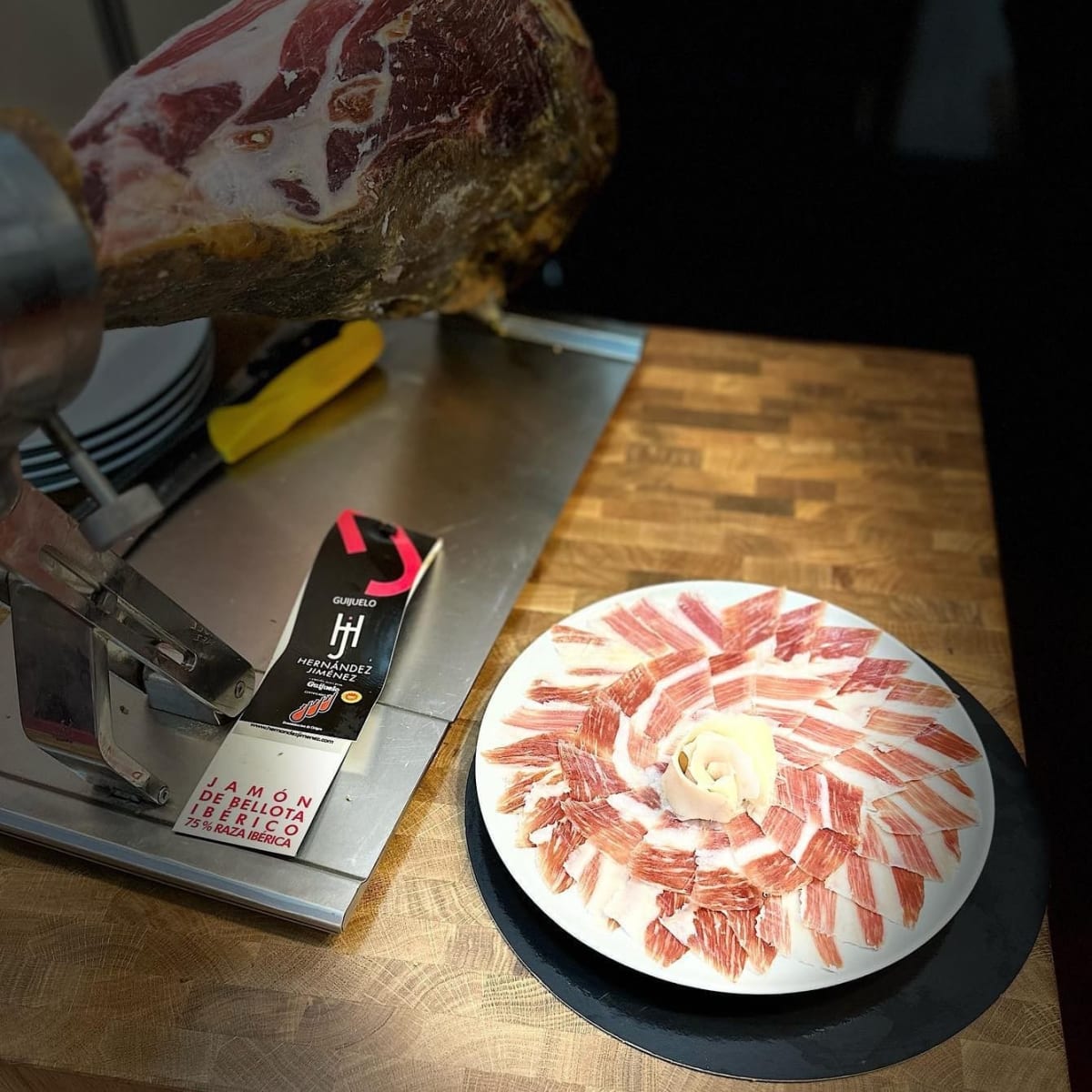
How to keep Iberian ham at home
An Iberian ham is not a finished product: it is a living one. It keeps evolving inside your kitchen just as it evolved during the years of curing in our natural cellar at 1,000 metres of altitude in Guijuelo. This guide gathers what we, over four generations of craft since 1890, have learned about caring for a piece once it leaves the cellar and reaches the customer’s home. No magic formulas: just common sense, patience and respect for the raw material.
When the piece arrives
When a good piece reaches your home, the first thing is to resist the temptation to start carving the same day. After the journey, the ham has gone through temperature changes, vibration and a humidity different from the cellar’s. It needs rest.
We recommend:
- Take the piece out of its packaging as soon as it arrives. Cardboard and plastics shouldn’t stay on: they stop the fat breathing and encourage condensation.
- Remove the cotton sleeve that many pieces carry, at least for a few hours, so the surface ventilates.
- Leave the piece hanging or on the ham holder, somewhere cool, for 24 to 48 hours before the first cut. That’s the time the ham needs to settle into the new environment.
- Inspect the piece visually: if there is yellowish outer lard, don’t remove it, it’s natural protection; if there is a spot of surface white mould, don’t be alarmed either (we cover that below).
Once acclimatised, the piece is ready to start.
Ideal temperature and humidity
Iberian ham needs a cool, dry and stable environment. Extremes are its enemy: not heat, not fridge cold, not the damp of a humid cellar, not the dryness of a heater.
As a practical rule for a normal home:
- Temperature: roughly between 15 and 22 degrees. Below 10 degrees the fat hardens and loses aroma; above 25 degrees the piece sweats and the fat starts to oxidise prematurely.
- Humidity: a dry, ventilated environment, without being desert-like. A pantry, a domestic cellar or a cool area of the kitchen away from the oven usually work well.
- Light: shade. Direct light, especially sun, oxidises the surface fats and alters the flavour within days.
- Smells: ham absorbs aromas easily. It shouldn’t be kept near cleaning products, very ripe fruit, mature cheeses or tobacco.
A whole piece must never go in the fridge. Cold halts the natural maturation, the fat compacts and the ham loses its unctuousness. The fridge is meant for already-packaged sliced envelopes, not for whole pieces.
Hanging or on a holder
Both options are valid, each with its own logic. There isn’t a single correct way here.
Hanging by the hoof, the piece stays in the same position it was cured in. Gravity helps the fats settle naturally and the piece takes up less space. It’s the best option if you’re not going to start carving yet, or if you eat it at a leisurely pace.
On the holder, the piece is fixed and carving is more comfortable. It’s the usual choice once you decide to open it. The holder should be stable, with a good grip, and placed on a firm surface away from heat sources. If you’re going to keep it on the holder for several months, turn it once every two or three weeks so the fat distributes and the piece doesn’t always dry out on the same side.
If you’re unsure when to switch from the horizontal position (babilla up) to the maza (maza up), that’s already carving territory and we cover it in detail in the how to carve a ham guide.
How to protect the cut once opened
This is the point where most pieces get spoiled at home. The exposed cut face is the vulnerable area: it loses moisture by evaporation, oxidises with the air and, if you don’t protect it, in a few days turns into a hard, dark crust.
Our long-standing method, the one we’ve been recommending for decades:
- Keep the fatback that comes off when you peel the piece. Don’t throw it away. It’s the best natural cover there is.
- After each carving session, smooth the cut surface with the knife to leave it clean and flat.
- Cover the whole cut area with the strips of fatback you kept, fitting them well.
- Over the fatback, a layer of cling film or a clean cotton cloth helps stabilise the humidity. The film goes directly over the fatback, not over the meat.
- If it’ll be more than a week before you carve again, add over the fatback a thin layer of the piece’s own lard (the yellowish outer fat, lightly softened between your hands). It seals better than fatback alone.
When you carve again, remove the film, lift the fatback, recover the dried-out surface layer with a pass of the knife and start with a clean slice. The fatback is reused over several sessions, until it goes rancid.
Monthly maintenance: the sunflower-oil trick
If the piece is going to last more than a month at home, simple maintenance is worthwhile. The trick that here in Guijuelo has been handed down from parents to children is the sunflower oil one (not olive oil, which brings its own flavour and can interfere):
- With a clean kitchen brush or a soaked cloth, give a very thin coat of sunflower oil over the outer rind and the skin, once a month.
- Avoid touching the cut area with the oil. The oil is only for the outer part of the piece, not for the meat.
- This keeps the rind flexible, stops it cracking and makes it harder for unwanted moulds to settle.
It’s a five-minute gesture that adds weeks of useful life. No chemicals, no antibacterials: just neutral vegetable oil.
How long a piece lasts
A whole acorn-fed piece, well kept at home, lasts perfectly well between three and six months from when you start carving, depending on the environment, the rate of consumption and the care. The longer it takes to be eaten, the more important the monthly maintenance.
Signs that something is wrong:
- A sour, ammonia-like or putrid smell in the cut area (not to be confused with the intense, natural aroma of cured ham).
- Green, black or bluish patches that penetrate into the interior of the meat (surface white moulds are harmless, the dark, deep ones are not).
- Softened, slimy or sticky meat.
- A clearly unpleasant rancid taste, especially in the fat.
If any of these signs appears, generously remove the affected area (several centimetres) and, if the problem persists or reaches the deep meat, don’t eat the piece. A healthy piece, by contrast, improves over the first weeks after opening, just as a good wine opens up after being uncorked.
Vacuum-packed slices: keeping and reviving
Vacuum-packed sliced envelopes have their own logic. Here at Hernández Jiménez we prepare them in the same facilities where we cure the more than 40,000 pieces we produce each year, and the basic rule is:
- Keeping: in the fridge, roughly between 4 and 8 degrees, until the best-before date on the envelope (usually several months from packing).
- Once the envelope is open, the slices should be eaten within a few days, ideally between two and four, covered and refrigerated.
- Don’t freeze unless genuinely necessary: freezing alters the texture of the fat and reduces the aromatic nuances. If there’s no alternative (an envelope you won’t eat in time), the sealed envelope can be frozen, but always thaw in the fridge, never at room temperature.
The key step many people skip: revive the slices before serving. Take the envelope out of the fridge, open it and let the slices rest on the plate at least five minutes at room temperature before eating. Ten is better if the plate is large. That’s the time the fat needs to partially melt and release all its aromas. Eating it straight from the fridge is wasting half the product.
An extra trick: if the plate is slightly warm (not hot: warm, like a hand placed on it), the fat releases even better.
FAQ
Can Iberian ham be frozen?
It isn’t advisable. Iberian fat loses structure when frozen and thawed, and the result in the mouth is noticeably inferior to the fresh product. If it’s absolutely necessary (an envelope you won’t eat before the use-by date), freeze in sealed vacuum envelopes and always thaw in the fridge, slowly. A whole piece is never frozen.
What to do with the white moulds that appear on the piece?
Surface white or greyish-white moulds are completely normal and part of the natural curing. They appear on pieces cured for 36 months, like our acorn-fed ones, and are a sign of a good environment. They clean off easily: a clean cloth lightly dampened with olive or sunflower oil, gently rub the area, and done. Only dark-coloured moulds (strong green, black, bluish) that penetrate inward should worry you.
Should the piece be cleaned with vinegar?
No. Vinegar, especially wine vinegar, brings acidity and smells that the ham absorbs easily and that alter the flavour of the following slices. For surface cleaning, a clean cloth is enough and, if needed, a drop of neutral vegetable oil. Leave the vinegar for the salad.
An open envelope — how long does it last in the fridge?
Between two and four days in optimal conditions: well covered (ideally wrapped in cling film or in an airtight container) and in the coldest part of the fridge. After that, the slices lose aroma and the fat starts to oxidise, although it remains safe to eat for some time longer.
Can I keep the whole piece in a wine cellar?
Yes, as long as the temperature doesn’t usually drop below 12–14 degrees and the humidity isn’t excessive. Climate-controlled wine cellars tend to run too cold for ham (usually around 10–12 degrees), which slows the piece’s evolution. It works, but it isn’t the ideal environment. A cool, ventilated pantry usually gives a better result.
Keeping a ham well is, in the end, a mix of a few things: stable temperature, protecting the cut and a little monthly attention. If you want to know exactly what you have in your hands before buying the next piece, we recommend reading our guide to bands and seals to tell categories and certifications apart at a glance. And if you’d like to know how we cure in Guijuelo, the four generations of craft behind every piece and why we co-founded the Guijuelo PDO in 1986, we tell it there at leisure.
Ham is patience. Three years in the cellar, a few weeks in your home: time always plays in favour of those who know how to wait.