Iberian ham price per kilo in 2026: complete guide
An Iberian ham can cost €200 or it can cost €1,200. Both are Iberian hams, both are on the market and both are sold as such. The difference is not arbitrary nor is it merely marketing: it comes down to specific, verifiable factors that determine the cost of production and, therefore, the final price.
This guide explains what lies behind that price variation, what you can expect in each category and the most direct way to buy with confidence without paying more than necessary.
The 4 factors that determine the price per kilo
1. The breed of the pig
Spanish legislation classifies Iberian ham into three levels of breed purity: 50%, 75% and 100% Iberian. The pure 100% Iberian pig — both parents of Iberian breed — is the rarest and the most expensive to raise. Crossing with Duroc at 50% or 75% produces larger animals with a higher meat yield, which lowers the unit cost.
Breed influences the organoleptic profile: the 100% Iberian has finer fat infiltration, a silkier texture and greater aromatic complexity, especially in the bellota (acorn-fed) categories. At the same diet and curing level, the 100% purebred always commands a higher price.
2. Diet during the montanera
This is the single most decisive factor in the price. The colour label sets the standard:
- White label (cebo): the pig has been fed on grain and compound feed on a farm throughout its life. This is the most accessible segment, with guaranteed quality but without the complexity that bellota brings.
- Green label (cebo de campo): the pig has grazed freely but without access to acorns. Better profile than pure grain-fed, at an intermediate price.
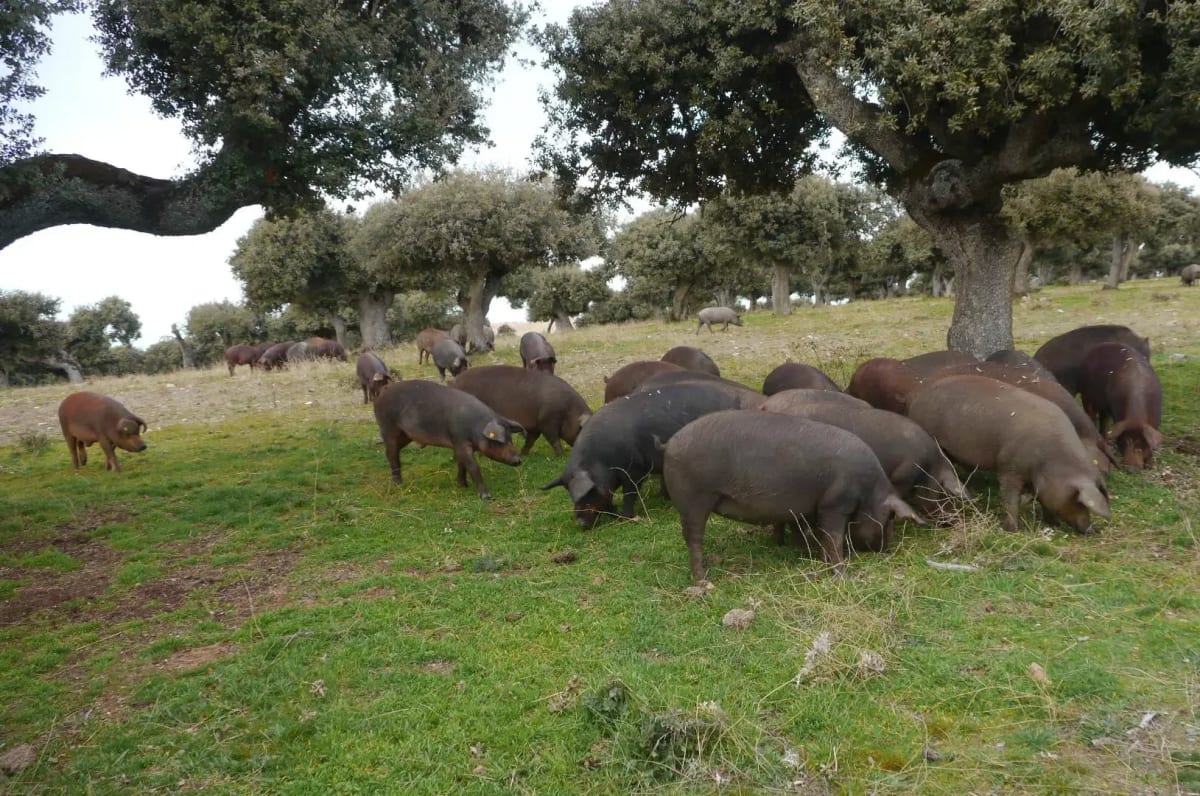
- Red label (bellota 75% Iberian): the pig has fattened in the dehesa (oak woodland pasture) eating acorns during the montanera season (October–February). The acorn diet produces fat with a high oleic acid content that infiltrates the meat and gives it its characteristic flavour.
- Black label (bellota 100% Iberian, pata negra): the same acorn-fed conditions but with full breed purity. The rarest and most expensive product in the entire classification.
Raising pigs in the dehesa during the montanera is far more costly than grain feeding on a farm: lower animal density per hectare, a longer production cycle and dependence on the natural acorn harvest, which varies year to year. That cost is reflected directly in the price.
3. Curing time
A grain-fed Iberian ham needs between 18 and 24 months of curing to develop its flavour profile. A top-range bellota ham can exceed 48 or even 60 months. Each additional month in the cellar represents costs of space, energy and tied-up capital. It is no minor detail: the great bellota 100% Iberian hams that cure for four or five years have a significantly higher production cost than one cured for 18 months, even if the raw material were identical.
Curing also acts as a quality filter: only the pieces with the right fat infiltration and correct salt level can withstand long curing without developing defects.
4. The Protected Designation of Origin
There are four PDOs for Iberian ham in Spain: Guijuelo, Jabugo, Dehesa de Extremadura and Los Pedroches. Each has its own regulations setting requirements for breed, diet, geographical rearing area and minimum curing time.
DOP Guijuelo, based in Salamanca, is the designation with the highest volume and longest track record. Guijuelo’s microclimate — at 1,000 metres altitude, low humidity and cool summers — favours slow, even curing that produces hams with a clean flavour and consistent texture. No PDO is objectively superior to the others: they are simply different profiles. But DOP Guijuelo is the highest-volume benchmark, with consolidated quality controls and a price-to-quality balance that make it the most solid choice for the discerning consumer.
Comparative price table by category (2026)
The following prices are indicative market prices for a whole leg with bone. Sliced vacuum-packed ham and paletas (front legs) have different price ranges (see the next section).
| Category | Label | Minimum curing | Whole leg price | Approx. price per kilo |
|---|---|---|---|---|
| Iberian cebo ham 50% | White | 18–24 months | €200–280 (~7 kg) | €28–40/kg |
| Iberian bellota ham 75% | Red | 36 months | €350–480 (~7 kg) | €50–68/kg |
| Iberian bellota ham Summun 75% | Red premium | 42 months | €500–650 (~7 kg) | €70–93/kg |
| Iberian bellota ham 100% pata negra | Black | 48–60 months | €800–1,200 (7–8 kg) | €100–150/kg |
The ranges reflect real market variability according to producer, point of sale and montanera year. The same category can cost 20–30% more in a gourmet shop in central Madrid than when bought directly from the producer in Guijuelo.
Why direct cellar prices are lower
The traditional Iberian ham distribution chain runs from the producer to the wholesale distributor, then to the retailer or gourmet shop, and finally to the consumer. Each link adds a margin. In higher-price categories, that accumulated margin can represent between 25% and 40% of the final price.
Buying directly from the producer eliminates all middlemen. Hernández Jiménez, with its cellar in Guijuelo, sells online without distributors: the price you see is the origin price, with delivery in 24–48 hours from the cellar.
The same DOP Guijuelo ham that might cost €480 in a gourmet shop in Madrid can be purchased at source for €350–380. This is not a one-off discount: it is the structural difference between a price that includes a distribution chain and a direct price.
Added to this is traceability: every piece is identified with its DOP seal number, which allows you to verify the origin, breed, diet and months of curing. This is not information the producer needs to explain — it is on the official seal. That is a guarantee no middleman can offer better than the producer themselves.
Sliced vs whole leg: real price per serving
The comparison between a whole leg and vacuum-packed sliced ham often causes confusion. The price per kilo of sliced ham is considerably higher than that of a whole leg, but the analysis requires nuance.
Whole leg: a larger initial investment, but a lower cost per actual serving. A 7 kg leg has a usable yield of between 55% and 65% of gross weight (once bone, trotter and rind are discounted), leaving between 3.8 and 4.5 kg of edible ham. At €360 for the leg, the real cost per kilo of consumable product is between €80 and €95. It requires a ham stand (jamonero), a carving knife and some skill in slicing.
Vacuum-packed sliced ham: the price per kilo is noticeably higher. A 100 g pack of 75% bellota ham typically costs between €15 and €25, equivalent to €150–250/kg. However, there is no waste: you pay for exactly what you eat, with no bone or rind, and no equipment or technique required. For occasional consumption, small families or people without a ham stand, it is the most rational option even if the unit price is higher.
Iberian paletas: the front leg of the pig. Smaller in size (4–5.5 kg), same category and diet as the corresponding ham. The price is usually between 40% and 60% of the equivalent ham price. The meat yield is similar in proportion, but the bone is more irregular and carving is somewhat more complex. For those who want bellota quality with a lower outlay, the paleta is the most direct alternative.
Where to buy Iberian ham at the best price with guarantees
The purchasing channel matters as much as the product itself. These are the most common options and their real implications:
Direct PDO producer (online or at the cellar): the most reliable option on all three axes that matter: origin price with no middlemen, quality certified by the PDO and full traceability. Delivery from the cellar within 24–48 hours guarantees that the cold chain and transport conditions are correct.
For a curated comparison of options, our guide to the best Iberian ham from Guijuelo online covers the key criteria for buying with guarantees.
Specialist gourmet shops: good service and advice, but higher prices due to distribution margins. Suitable if you value in-person assistance and do not have direct access to the producer.
Supermarkets: acceptable for grain-fed ham in basic categories. For bellota or higher categories, high turnover and storage conditions are not always optimal. Traceability is also harder to verify.
General marketplaces: variable pricing, quality difficult to verify. The risk of receiving a poorly stored or dubiously sourced product is higher than buying directly from the producer.
If you are looking for DOP Guijuelo Iberian ham at origin prices, with full traceability and delivery from the cellar, Hernández Jiménez offers every category in the official classification — from 50% cebo to 100% bellota pata negra — with no middlemen.