The definitive guide to understanding the difference between serrano ham and Iberian ham
When shopping at jamongourmet.es, one of the most common questions is understanding exactly what separates a serrano ham from an Iberian one. Although both are gems of Spanish gastronomy, they come from entirely different worlds in terms of genetics, rearing and nutritional profile.
Understanding the product requires the same analytical rigour we would apply in scientific or biological research. Here we break down the key variables so that your purchasing decision is an absolute success.
The genetics: white pig versus Iberian pig
The fundamental difference lies in the breed of the animal, which determines its morphology and metabolism.
Serrano ham: Comes from white-coated pigs (breeds such as Duroc, Pietrain, Landrace or Large White). Their genetics do not allow them to infiltrate fat into the muscle in any significant amount.
Iberian ham: Comes from the Iberian pig, a native breed of the Iberian Peninsula. Its most notable physiological trait — and the secret of its gastronomic success — is its capacity to store fat infiltrated between muscle fibres. This gives rise to the famous marbled texture that melts in the mouth.
Habitat and diet: from the farm to the dehesa
The environment and diet determine the quality of the fatty acids and the final flavour of the product.
White pigs destined for serrano ham are usually raised in intensive systems and their feed is based primarily on compound feeds made of cereals.
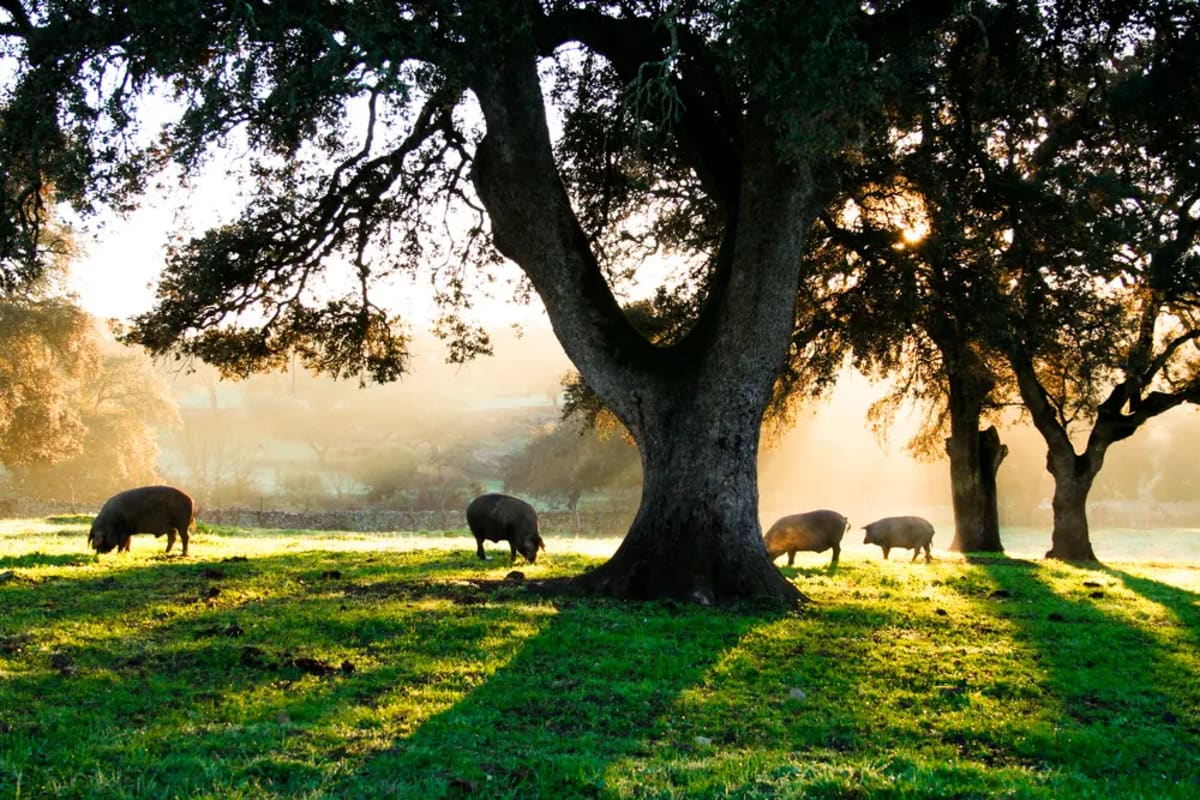
By contrast, the ultimate expression of the Iberian pig is achieved when the animal lives freely in the dehesa during the “montanera” period. There it feeds exclusively on acorns, grasses and roots. This diet, rich in oleic acid, transforms the animal’s fat into a product of great cardiovascular interest, with lipid profiles that are often fascinating from the perspective of human physiology.
Curing times: the patience of the master ham curer
The drying and maturing process also marks a clear boundary. Iberian pig meat, having a greater amount of infiltrated fat, requires significantly slower biochemical curing processes.
Serrano curing: Times generally range between 9 and 15 months. Depending on the maturation period, they are classified as Bodega (9–12 months), Reserva (12–15 months) and Gran Reserva (over 15 months).
Iberian curing: It rarely falls below 24 months and, in large 100% Iberian acorn-fed pieces, the process in a natural cellar can extend from 48 to 60 months.
Sensory analysis: how to tell them apart on the plate
Even without being an expert, sight, touch and taste offer unmistakable clues.
| Characteristic | Serrano ham | Iberian ham |
|---|---|---|
| Meat colour | Pink or light red, matt | Deep purple-red and bright |
| The fat | White, harder and concentrated on the outside | Translucent, soft, melts at room temperature |
| Aroma and flavour | Mild, slightly salty and less persistent | Intense, full of nuances (umami) and very persistent |
| Morphology (trotter) | Usually white hoof and thick shank | Thin, elegant shank, dark hoof or “pata negra” |
Designation of origin and labelling: learn to read the label
Spanish regulations establish a colour-coded labelling system for Iberian ham that greatly facilitates the purchasing decision:
- Black label: Bellota 100% Iberian ham (pata negra). The ultimate expression: pure breed and exclusive acorn diet during montanera.
- Red label: Bellota Iberian ham. The animal is Iberian (at least 50% of the breed), but not necessarily of pure breed.
- Green label: Free-range cebo Iberian ham. Raised in freedom with feed and natural field resources, without montanera.
- White label: Cebo Iberian ham. Raised in facilities and fed with compound feed.
Serrano ham, for its part, has the Guaranteed Traditional Speciality (GTS) certification which certifies its curing process, but does not establish the same colour system.
Price: why is Iberian ham more expensive?
The price difference reflects a chain of objective factors:
- Higher rearing cost: The dehesa as an ecosystem has a limited carrying capacity. A montanera Iberian pig needs between 1 and 2 hectares of dehesa to feed.
- Higher-value feed: Acorns are a seasonal resource that cannot be industrially controlled.
- Longer curing time: Between 24 and 60 months compared to 9–15 for serrano means a much greater amount of immobilised capital for the producer.
- Lower meat yield: The Iberian pig produces more slender pieces with greater weight loss during curing.
Which should you choose?
Both have their place in the larder, but they serve different needs:
Serrano ham is an everyday option with an excellent price-to-quality ratio: versatile in cooking, ideal for tapas, sandwiches or charcuterie boards without straining the budget.
Iberian ham, especially the bellota variety, is a product for special occasions and conscious enjoyment: its aromatic complexity and nutritional profile place it in a category of its own. It is the right choice when the product is the absolute star of the table.
At jamongourmet.es we work exclusively with Iberian ham from Guijuelo under the D.O.P. Guijuelo, with complete traceability from the dehesa to your table. All our animals are raised in the traditional way, free-range and with natural feed. Quality certified throughout the entire process, with no intermediaries altering the conditions of rearing, slaughter or curing.
Beyond ham, our Guijuelo factory also makes Iberian charcuterie from the same pig and the same natural curing: chorizo, salchichón, loin and morcón de bellota. Discover them in our Iberian charcuterie from Guijuelo selection.