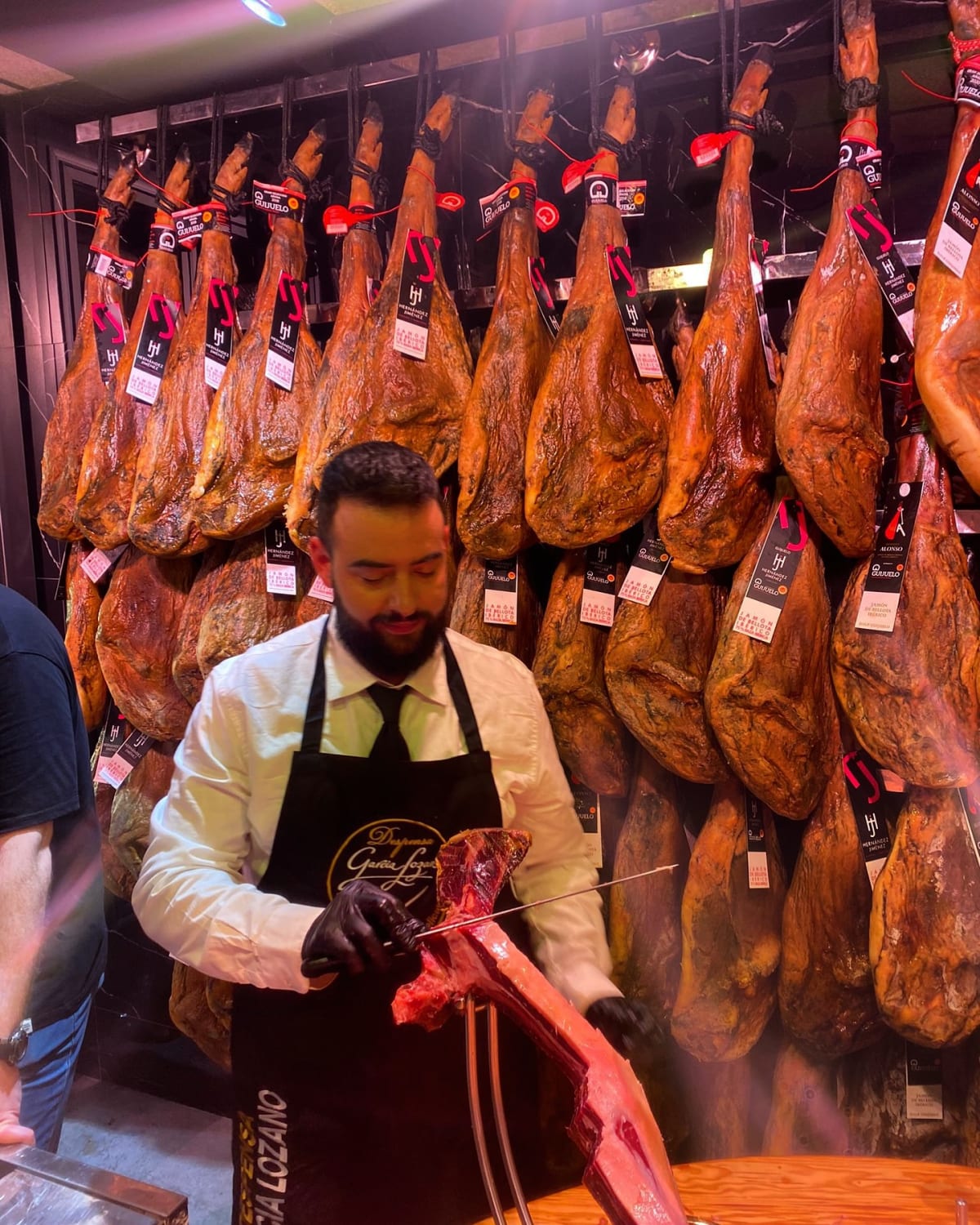
Carving ham by knife: why we do it this way at Hernández Jiménez
In 130 years, in our cellar there has only been one way to carve: by knife. It isn’t nostalgia, it’s respect for what the pig, the dehesa and time have created. But we completely understand that, in a home, a slicing machine can make sense. Here are the honest arguments for and against each, no dogmatism.
Why we carve by knife in the cellar
In Guijuelo, in our cellar, knife carving isn’t a marketing decision. It’s the only way we know to honour a piece that has taken between 36 and 48 months to be ready. These are the technical reasons, not the romantic ones:
- It respects the muscle grain and doesn’t heat it. The ham knife’s edge enters between the fibres without tearing them. The rotating blade, by contrast, works by friction and raises the fat’s temperature in seconds.
- It allows control of thickness and shape slice by slice. Each area of the ham — maza, contramaza, babilla, punta — calls for a different thickness. The maza takes more generous slices; the contramaza, almost translucent ones. A machine, calibrated in fixed millimetres, doesn’t understand that.
- It identifies defects in real time. A dry area, a sinew, a point of bone: the carver detects them by touch before serving. The machine keeps cutting until you stop it.
- The master carver directs the cut towards the most appealing area. They know how to read the piece and offer the diner the best of each moment of consumption.
- Tradition: our carvers learn by watching, not by reading manuals. They spend years beside a master before touching an acorn-fed piece. You can get to know that silent transmission better on our masters page.
The 4 real advantages of knife carving at home
Let’s go to what really shows when a slice reaches the palate:
- A thinner, more translucent slice. A skilled carver easily goes below 1 mm thick. A mid-to-high-end home machine rarely goes below 1.5 mm without breaking the slice.
- An irregular shape that respects the grain. The hand-cut slice has an organic, almost leaf-like shape. The machine makes perfect strips, but soulless ones; visually uniform and, in the mouth, flat.
- Aroma released instantly. A clean cut in the cold preserves the volatiles. The blade’s friction heat causes an immediate partial oxidation: part of the aroma evaporates before reaching the plate.
- The texture in the mouth changes. The knife leaves a more “alive” slice, with minimal reliefs that retain juice and fat. The machine slice is flatter and, when it melts, does so more predictably and less complexly.
The 4 real advantages of the slicing machine
Let’s also acknowledge what the machine does better. Denying it would be dishonest:
- Speed. Two hundred grams in thirty seconds with a good slicer. By knife, that same amount takes a professional between five and eight minutes.
- Uniformity. For catering plating, banquets or fast bar service, that regularity is a real advantage.
- It requires no technical skill. Anyone with a decent machine can serve an acceptable slice. Learning to carve by knife takes years.
- When the piece runs out, in the hock area, the machine scrapes the bone better. It makes use of pieces that by knife are harder to extract without losing shape.
What we tell our customers when they ask
We always sum it up in two scenarios:
- Immediate consumption and a diner who appreciates nuances: knife, always. No debate. If you’re going to open the envelope or serve the piece within days, and the diner knows what’s in front of them, knife carving makes the difference.
- Slow consumption over months, or a large-quantity event: machine at home, or prior professional knife carving with vacuum packing. Especially if the piece will be open for weeks, the machine offers a consistency an amateur carver hardly achieves.
When someone buys their first whole piece, we always point them to read the first cut of the ham before considering machine or knife. The whole piece has its own liturgy.
The mistake to avoid with the machine
If you work with a machine, this is the nuance almost no one mentions: speed generates heat by friction. In long consecutive cuts — more than 200 or 300 grams without a pause — the blade’s fat heats up and “stresses”, losing aroma. The slice comes out glossy, but flat in the mouth.
The right way: pauses every 100 grams, let the blade cool a couple of minutes, clean off the fat oil that builds up. It isn’t paranoia; it’s what separates a well-used machine from one that destroys the product.
Another detail: the blade must be perfectly sharp. A machine with a tired edge doesn’t cut, it tears. And then temperature doesn’t matter: you’re already losing the ham.
To go deeper into the manual technique, we recommend our complete guide on how to carve ham, where we explain step by step the stance, the knife angle and the order of the areas.
How we ask for knife carving in a shipment
In our catalogue, the pieces shipped knife-sliced are cut by our own professional carver at our facilities in Guijuelo. The process is always the same:
- The piece tempered to the right point before carving. Neither cold from the chamber nor warm from the room.
- Knife carving by a professional, not by a machine disguised as a knife.
- Immediate vacuum packing, without the slice spending more than a few minutes in the air.
- 100-gram envelopes, separated with food-grade plastic so the slices don’t stick together on opening.
You can see the format and the product on the page for our 100% Iberian acorn-fed pata negra ham, Guijuelo PDO. When it reaches home, just take the envelope out of the fridge about fifteen minutes beforehand and serve straight away.
FAQ
What’s the ideal temperature of the slicing machine? The machine itself doesn’t “heat up” deliberately, but the blade does, by friction. The ideal is to work in a cool kitchen, around 18–20 ºC, and take short pauses every 100 grams. The ham, before carving, should be between 22 and 24 ºC so the fat expresses itself; if it’s too cold, the slice doesn’t perfume.
Can I order the piece already vacuum-cut and thaw it? Our envelopes aren’t frozen; they’re vacuum-packed and kept refrigerated. Freezing, for acorn-fed Iberian ham, isn’t recommended: it breaks part of the fat structure and it shows on thawing. Vacuum in refrigeration keeps the piece optimal for weeks.
Can the difference between knife and machine really be tasted? Yes, but it requires an attentive diner. In a blind tasting, most enthusiasts detect more aroma and a different melt in the knife-cut slice. In distracted consumption, standing or amid conversation, the difference fades. That’s why we say: knife for the occasion, machine for the everyday.
How long does a professional take to carve a whole piece? A whole acorn-fed piece, around 7.5 kilos, takes a skilled carver between four and six hours of net work. That includes trimming, removing the rind, separating the areas, slice-by-slice carving, making use of the bone and cleaning. It isn’t quick work, and that’s why the professional service has the price it has.
What happens to the bone afterwards? The bone is gold for stocks. Once the meat is exhausted, we chop the central bone and use it for stocks, stews or Castilian soups. It brings a depth of flavour no stock cube reaches. It’s worth blanching it briefly before adding it to the pot to remove excess surface fat.
If you want to take the step and try knife carving in its most careful form, we invite you to discover our 100% Iberian acorn-fed pata negra ham, Guijuelo PDO. And if what you have in your hands is a whole piece to open for the first time, don’t miss our article on the first cut of the ham: it’ll save you mistakes that weigh later.